That foundation shaped everything that came after.
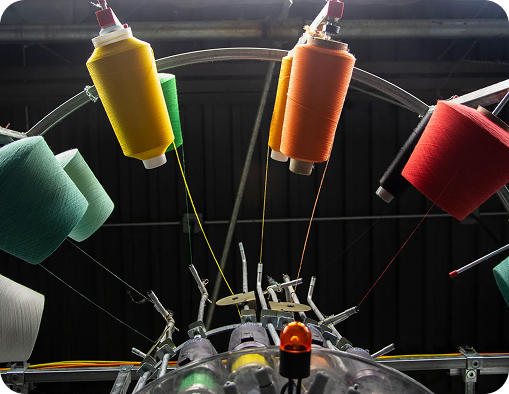
Because of it, we know what our partners actually need: short lead times, a wide range of colored yarn access, various silhouettes for different end uses, and support beyond the knitting machine — packaging, logistics, and guidance when decisions aren’t obvious. Most of all, they need a manufacturer they can trust to handle the complexity so they can stay focused on selling and growing their business.
We didn’t arrive here by accident.
We earned our place by taking on work that didn’t fit — and learning why. We ran programs with materials that shouldn’t have been run. We pushed designs that technically worked but never should have been approved. We’ve walked away from jobs that we could have forced through, because forcing work through always costs someone more in the end.
That experience taught us what partner fit really means.
We’re direct about it. If we’re not the right manufacturer for your program, we’ll tell you early. Not because we’re selective for the sake of it — but because the wrong fit creates friction, missed expectations, and expensive mistakes. We’d rather you succeed somewhere else than struggle with us.
Quality is where that philosophy matters most.
For some companies, socks are a disposable marketing item. For others, they’re a reflection of their reputation. A local construction company giving merino wool socks to employees and customers carries a different risk than a tech company handing out giveaways at a trade show. If that sock fails, the assumption isn’t that the product was cheap — it’s that the business behind it cuts corners. We understand this, because we’ve worked with both.
We design and manufacture with that weight in mind.
That’s why we obsess over inputs. We resource our supply chain carefully, monitor it constantly, and re-resource when standards slip. We invest in equipment that is often more capable than our programs strictly require — not because it’s impressive, but because it gives us control, consistency, and repeatability. Yes, some of this work could be done on older, cheaper machines. We choose not to. That decision is intentional.
Our pricing reflects those choices.
We are not the lowest-cost option, and we don’t try to be. We’re not private equity–backed. We don’t optimize for margin at the expense of people, process, or product. We invest in our team — in predictable schedules, transparency, benefits, and a work environment where experience stays instead of walking out the door.
If you’re sourcing solely on knit cost, overseas manufacturing may be a better fit. Our value shows up in execution, communication, problem-solving, and accountability — not in being the cheapest line item.
Operationally, we run lean by design.
We don’t sit on months of speculative inventory. We plan instead of reacting. We use data to guide decisions, not to justify them after the fact. We’ve built long-term relationships with vendors that give us options others don’t have — access, flexibility, and reliability when things get tight. Those relationships weren’t accidental; they were built deliberately over time. We also choose to source locally whenever possible, even when the economics alone wouldn’t force that decision. North Carolina built this industry — and it built us. Keeping work, knowledge, and economic impact in the region matters to us, even when it’s harder.
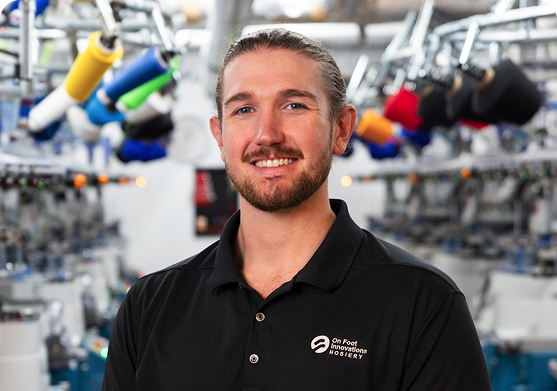
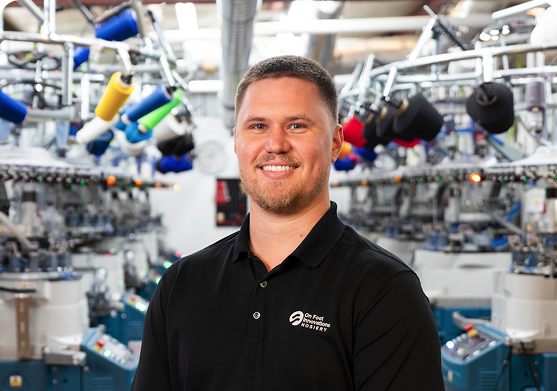
Many of us grew up in knitting mills. We watched plants close and families lose their livelihoods. We saw generations of technical knowledge disappear when mills couldn’t adapt. We understand what’s lost when experience leaves the floor and never comes back. We’re proud to be contributing to the next chapter of North Carolina hosiery manufacturing — not just producing socks, but rebuilding technical depth, capability, and standards that last.